The Euthanasia Coaster is a concept for a steel roller coaster designed to kill its passengers. In 2010, it was designed and made into a scale model by Julijonas Urbonas, a PhD candidate at the Royal College of Art in London. Urbonas, who has worked at an amusement park, stated that the goal of his concept roller coaster is to take lives “with elegance and euphoria.” It is a ride to the death. The seven loops or “inversions” put the human body under such stress that it causes the brain to be starved of oxygen, as the heart simply cannot push blood against the enormous g-forces. Even if it kills you, it is designed to still be a fun death. An honourable thought, if rather macabre.
I can make a rollercoaster that kills people too.
and I dont have my phd
that doesn’t look like a fun death though
what about now?
Yeah good enough
It’s fucking wild but with that last addition this post is trans inclusive so great job everybody, we can pack it up and go home, this one was a success
Medieval castle stairs were often built to ascend in narrow, clockwise spirals so right-handed castle defenders could use their swords more easily. This design put those on the way up at a disadvantage (unless they were left-handed). The steps were also uneven to give defenders the advantage of anticipating each step’s size while attackers tripped over them. SourceSource 2Source 3
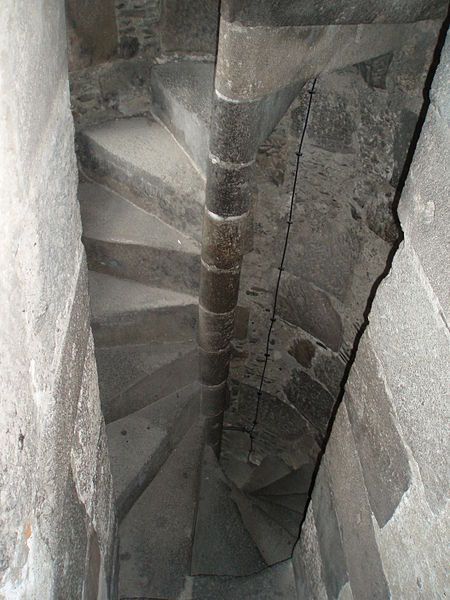
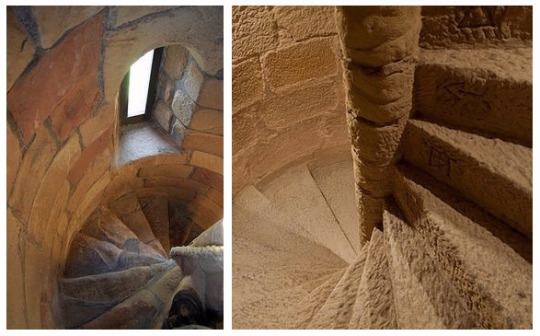
Not really the best illustration since it totally negates the effect by having a wide open space for those ascending. Castle tower staircases tended to look like this:
Extremely tight quarters, with a central supporting pillar that is very, very thoroughly in the way of your right arm.
Wider, less steep designs tend to come later once castles moved away from being fortresses to simply noble family homes with the advent of gunpowder.
Oh! Pre-gunpowder military tactics are my jam! I don’t know why, but this is one of my favorite little details about defensive fortifications, because the majority handedness of attackers isn’t usually something you think about when studying historical wars. But strategically-placed walls were used basically worldwide as a strategy to secure gates and passages against advancing attackers, because most of the world’s population is right-handed (and has been since the Stone Age).
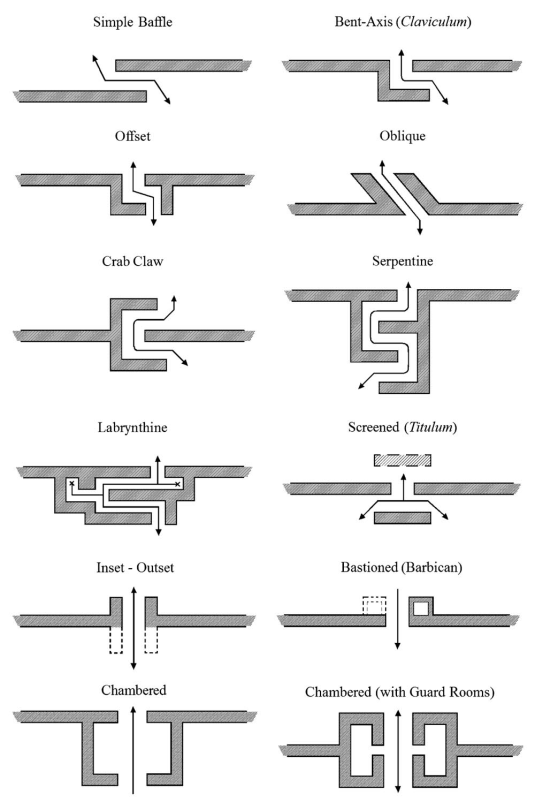
Pre-Columbian towns near the Mississippi and on the East coast did this too. They usually surrounded their towns with palisades, and they would build the entrance to the palisade wall in a zigzag – always with the wall to the right as you entered, to hinder attackers and give an advantage to the defender. Here’s some gates with some examples of what I’m talking about:
Notice that, with the exception of the last four (which are instead designed to congregate the attackers in a space so they can be picked off by archers, either in bastions or on the walls themselves) and the screened gate (which, in addition to being baffled, also forces the attackers to defend their flank) all of these gates are designed with central architectural idea that it’s really hard to kill someone with a wall in your way.
In every culture in the world, someone thought to themselves, “Hey it’s hard to swing a weapon with a wall on your right-hand side,” and then specifically built fortifications so that the attackers would always have the wall on their right. And I think that’s really neat.
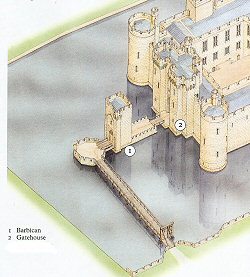
Ooh, ooh, also: Bodiam Castle in Sussex used to have a right-angled bridge so any attacking forces would be exposed to archery fire from the north-west tower on their right side (ie: sword in the right hand, shield on the useless left side):
These tactics worked so well for so long because until quite recently lefties got short shrift and had it trained (if they were lucky) or beaten out of them.
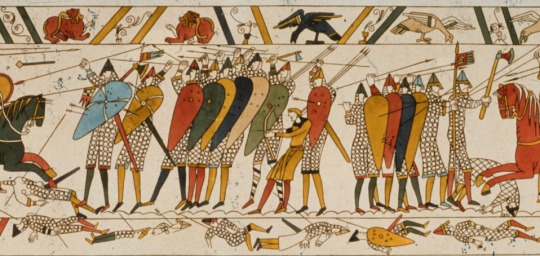
Use of sword and shield is a classic demonstration of how right-handedness predominated. There’s historical mention of left-handed swordsmen (gladiators and Vikings), and what a problem they were for their opponents, but that only applies to single combat.
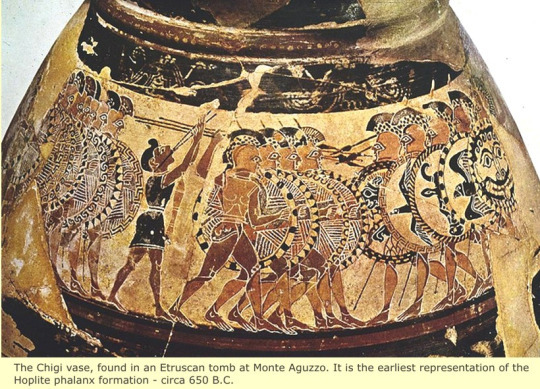
A left-handed hoplite or housecarl simply couldn’t fight as part of a phalanx or shield wall, since the shields were a mutual defence (the right side of the shield covered its owner’s left side, its left side covered the right side of his neighbour to the left, and so on down the line) and wearing one on the wrong arm threw the whole tactic out of whack.
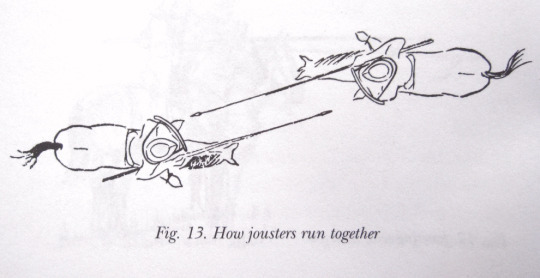
Jousting, whether with or without an Italian-style tilt barrier, was run shield-side to shield-side with the lance at a slant (except for the Scharfrennen, a highly specialised style that’s AFAIK unique.) Consequently left-handed knights were physically unable to joust.
The construction of plate armour, whether specialised tournament kit or less elaborate battle gear, is noticeably “right-handed“ – so even if a wealthy knight had his built “left-handed” it would be a waste of time and money; he would still be a square peg in a world of round holes and none of the other kids would play with him.
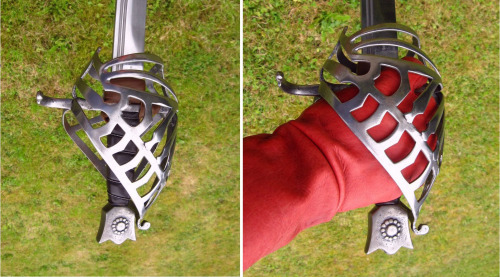
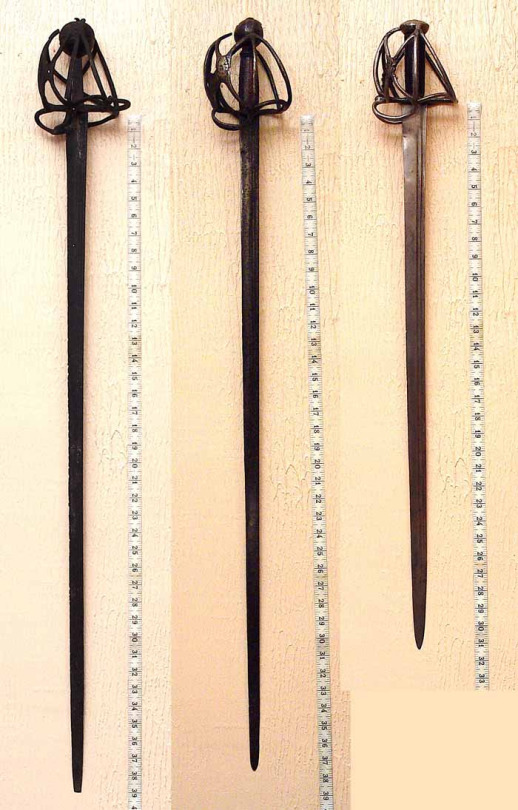
Even after shields and full armour were no longer an essential part of military equipment, right-hand use was still enforced until quite recently, and to important people as well as ordinary ones – it happened to George VI, father of the present Queen of England. Most swords with complex hilts, such as swept-hilt rapiers and some styles of basket-hilt broadsword, are assymetrical and constructed for right handers. Here’s my schiavona…
It can be held left-handed, but using it with the proper thumb-ring grip, and getting maximum protection from the basket, is right-handed only. (More here.) Some historical examples of left-hand hilts do exist, but they’re rare, and fencing masters had the same “learn to use your right hand” bias as tourney organisers, teachers and almost everyone else. Right-handers were dextrous, but left-handers were sinister, etc., etc.
However, several
predominantly left-handed
families did turn their handedness into advantage, among them the Kerrs / Carrs, a notorious Reiver family along the England-Scotland Borders, by building their fortress
staircases with a spiral the other way to the OP image.
This would seem to be a bad idea, since the attackers (coming upstairs) no longer have their right arms cramped against the centre pillar – however it worked in the Kerrs’ favour because they were used to this mirror-image of reality while nobody else was, and the defender retreating up the spiral had that pillar guarding his right side, while the attacker had to reach out around it…
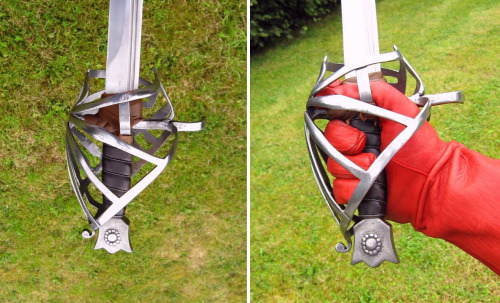
For the most part Reiver swords weren’t elaborate swept-hilt rapiers but workmanlike basket-hilts. Some from Continental Europe have the handedness of my schiavona with thumb-rings and assymmetrical baskets, but the native “British Baskethilt” is a variant of the Highland claymore* and like it seems completely symmetrical, without even a thumb-ring, which gives equal protection to whichever hand is using it.
*I’m aware there are those who insist “claymore” refers only to two-handers, however the Gaelic term claidheamh-mòr
– “big sword” –
just refers to size, not to a specific type of sword in the way “schiavona” or “karabela” or even “katana” does.
While the two-hander was the biggest sword in common use it was the claidheamh-mòr; after it dropped out of fashion and the basket-hilt became the biggest sword in common use, that became the claidheamh-mòr.
When Highlanders in the 1745 Rebellion referred to their basket-hilts as claymores, they obviously gave no thought to the confusion they would create for later compilers of catalogues…
Also, muskets had their whole “Flint and steel and gunpowder” thing on the right side so if you tried firing it lefty you’d get a face full of fire. More recently, rifles eject their spent shell casings to the right, so if you’re a lefty you get some hot metal in your eye.
A Pennsylvania museum has solved the mystery of a Renaissance portrait in an investigation that spans hundreds of years, layers of paint and the murdered daughter of an Italian duke.
Among the works featured in the Carnegie Museum’s exhibit Faked, Forgotten, Found is a portrait of Isabella de’Medici, the spirited favorite daughter of Cosimo de’Medici, the first Grand Duke of Florence, whose face hadn’t seen the light of day in almost 200 years.
Isabella Medici’s strong nose, steely stare and high forehead plucked of hair, as was the fashion in 1570, was hidden beneath layers of paint applied by a Victorian artist to render the work more saleable to a 19th century buyer.
The result was a pretty, bland face with rosy cheeks and gently smiling lips that Louise Lippincott, curator of fine arts at the museum, thought was a possible fake.
Before deciding to deaccession the work, Lippincott brought the painting, which was purportedly of Eleanor of Toledo, a famed beauty and the mother of Isabella de’Medici, to the Pittsburgh museum’s conservator Ellen Baxter to confirm her suspicions.
Baxter was immediately intrigued. The woman’s clothing was spot-on, with its high lace collar and richly patterned bodice, but her face was all wrong, ‘like a Victorian cookie tin box lid,’ Baxter told Carnegie Magazine.
After finding the stamp of Francis Needham on the back of the work, Baxter did some research and found that Needham worked in National Portrait Gallery in London in the mid-1800s transferring paintings from wood panels to canvas mounts.
Paintings on canvas usually have large cracks, but the ones on the Eleanor of Toledo portrait were much smaller than would be expected.
Baxter devised a theory that the work had been transferred from a wood panel onto canvas and then repainted so that the woman’s face was more pleasing to the Victorian art-buyer, some 300 years after it had been painted.
Christ men have been Photoshopping women to make us more “pleasing” since for-fucking-ever.
Also, Isabella de’Medici is nice looking, but also has that look in her eye of all Medicis: “I haven’t yet decided whether I’m going to kick your ass, buy you and everything you own, or have sex with you. Perhaps all three.”
It’s interesting the way the repaint has photoshop!Isabella affecting a slightly dreamy, docile gaze into the middle distance; she’s dewy-faced and unthreateningly soft. But in the original, she’s looking you right in the eye. She takes the male gaze and throws it right back at you. That’s a face that says go on, tell me I’d be so pretty if only I had a little repaint, I dare you. I’ll fuck you up.
They also made her hand smaller and I can’t tell if that’s an urn or scepter in her hand but considering it was painted out I wouldn’t be surprised if it was a symbol of power.
Oh, it’s a symbol of power alright. She’s a Medici, daughter of Cosimo I de Medici, First Grand Duke of Tuscany. The Medicis were the most powerful political family in Florence for almost forever. In Florence, the lines between politics, crime, warfare, and the Church were very blurry. They even managed, on four separate occasions, to get one of their own family members elected Pope, usually by very underhanded dealing with the cardinals. They had their fingers in every pie in Italy from 13th through 17th century.
In the case of Isabella, in order to secure an alliance with the Orsini family of Rome, she was married to Paolo Giordano I Orsini when she was 16. Contrary to popular belief, people in Renaissance Europe weren’t all that into child brides, this was just about the politics, so she stayed at her father’s household in Florence until she was of appropriate age. And then she just sort of… never left. Her new husband had zero concept of money, and her dad actually kinda hated him even though he was the one who arranged the marriage in the first place. So Isabella and her 50,000 scudi dowry (at a time when the average Italian earned somewhere between 10 and 40 scudi a year)stayed in Florence. Because she never went to Rome to live with her husband, she enjoyed enormous freedom and power back in Florence. After her mother died, she basically stepped into the role of First Lady of Florence, and was considered one of the keenest political minds in Europe. She ruled what she wanted, bought what she wanted, and fucked who she wanted, with no one really able to tell her no.
She was eventually assassinated by her husband while she was on holiday at one of her family’s country villas, probably because she was fucking her husband’s cousin, Troilo Orsini. Well, she had an “accident” while bathing, and Paolo Orsini said she must have drowned, but the coroner said she was strangled, and several servants swore they saw him do it. He might also have done it on the orders of Isabella’s brother, Francesco Medici, since he was trying to consolidate his power as the next Grand Duke, and by all accounts she was definitely in his way because of her political savvy.
So yeah. She was a boss, and that’s what makes it even more offensive that this Victorian sap tried to make her into this passive, skinny, doe-eyed wimp.



 Site Title